
THE DATA
The data · private placement - not public record
Where the data comes from, and why it reaches you first.
Every other inherited-property list starts at a courthouse. Ours starts at the death record. That single difference is worth three to six months, and three to six months is the whole business.
The data · private placement - not public record
Private placement data, in plain English.
“Private placement” means the source isn't published, isn't scraped, and isn't for sale on the open market. We hold restricted access to a national death file and are permitted to use it for a narrow set of purposes. Access is licensed, audited and limited — which is exactly why it isn't sitting on a county website for anyone to pull.

It never touches a courthouse
Probate is a court filing, and court filings are public by law. A family typically files 3-6 months after a death — and only if the estate requires it. We're not waiting on that step, so we're not bound by its calendar.

It sees what probate never will
Many homes pass without a court case: trusts, transfer-on-death deeds, small estates. None of them show up on a probate list. We start from the passing, not the filing, so you see the property whether or not the estate ever goes to court.

No public trail to follow
Probate leads leave a paper trail that anyone can pull, and your competitors do. A private placement record has no county filing, no docket number and no public listing. The investor down the street can't find it at the courthouse. The only way to reach that family first is to already have the record.
HOW A RECORD IS BUILT
Four steps between a death record and your dialer.
STEP 01
Capture
The passing enters our database within 24–48 hours — name, date of birth, date of death, last known address.
STEP 02
Property match
We match the decedent to real estate they actually own, and append market and assessed value, open mortgage, lien holders, lot size and square footage.
STEP 03
Heir append
Contact data for up to five first-degree relatives — the people who will actually decide what happens to the house.
STEP 04
Assignment
The record is written to exactly one account key. That assignment is what makes exclusivity real instead of a sentence in a contract.
Account key
Unique record ID
Assigned date
When it became yours
Full Name
First, middle, last, suffix
Date of birth
& age of death
Date of death
Captured in 24-48 hrs
Last known mailing address
Where they received all mail
Property address
The home they owned
City / county / state
Your subscribed market
Market & assessed value
What's it worth
Open mortgage
& lien holders
Lot size & sq ft
Property detail
Heir contact data
Up to 5 first-degree relatives
Exclusivity is enforced. A record assigned to your account key is never assigned to another subscriber — which is why every row is an opportunity.
What this data is — and what it isn't.
We'd rather tell you now than have you find out in month two. If any of this is a dealbreaker, we'll say so on the call and save you the setup fee.
Not every decedent owned a home. Roughly 150,000 of the 250,000+ monthly records match to real estate — you're subscribed to the matched ones.
Not every heir answers the phone. Up to five relatives per record is coverage, and this increases the chance that some of the five are reachable.
This is early data, which means the family is early too. The call is a conversation about a house and a parent, not a pitch. Our scripts are built for that, and they're included.
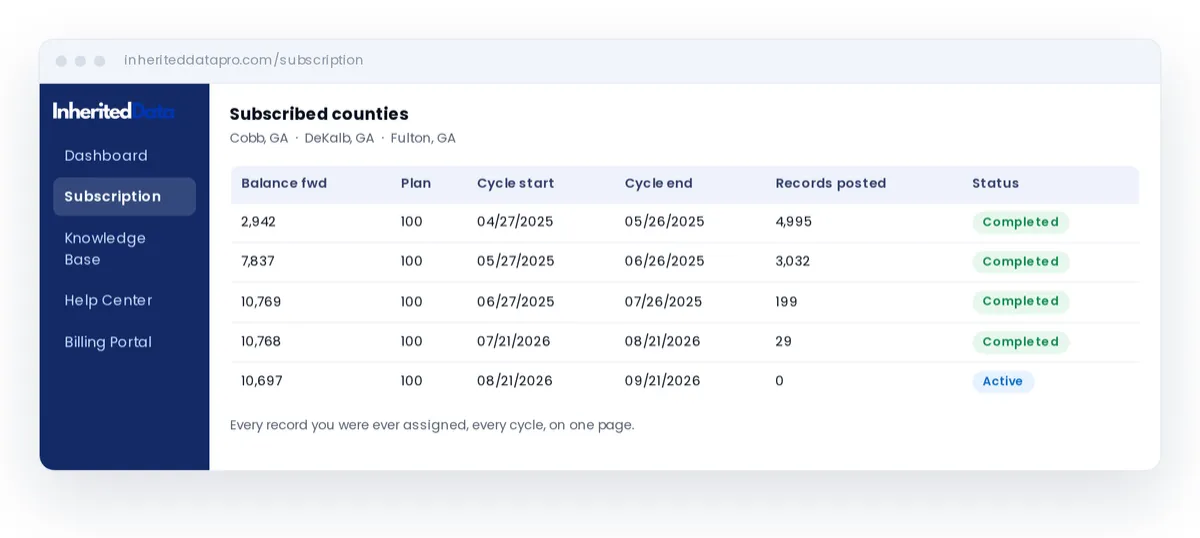
Volume varies month to month with your county's actual mortality. Your fulfillment ledger shows the real count every cycle, and any shortfall carries forward.
We don't sell the same record twice. If your county is claimed, we'll tell you it's closed rather than quietly double-assign it.
COVERAGE
Pick a county, an MSA, or a whole CSA.
Coverage is national, so your market is a subscription choice rather than a technical limit. Most subscribers start with the two or three counties they already farm and expand once the first deals close.
Because every record is exclusive, counties close. When one is claimed, it's off the board until that subscriber leaves — which is the honest reason we ask you to check availability before we talk price.
DELIVERY
It shows up in a platform, not an inbox.
Records are posted to your InheritedDataPRO dashboard, filterable by county and date of death, exportable to CSV in one click, and logged in a fulfillment ledger that shows every record we've ever posted to your account.
No spreadsheets over email, no wondering whether you got what you paid for.
See whether your county is still open.
Fifteen minutes. We'll check availability in your market, show you the data, and tell you straight if we can't cover you.
We are here to help!
Call or Text: (407) 706-9960
Private-placement inherited property data — surfaced 3 to 6 months before probate records become public.


Copyright 2026. Realty Mitigation Services, LLC. dba InheritedData. All rights reserved.